By Malini Prasad
Millions of people around the world are trapped in harmful global supply chains. The fast fashion industry, and multinational conglomerates must aid in stopping and preventing these human rights abuses. Therefore, the International Chamber of Commerce International Court of Arbitration (“ICC Court”) should adopt the United Nations Guiding Principles on Business and Human Rights (“UNGPs”) and the Hague Rules on Business and Human Rights Arbitration (“HR”) into their rules because these documents provide practitioners with a way to incorporate human rights protection mechanisms into contracts and arbitration processes.
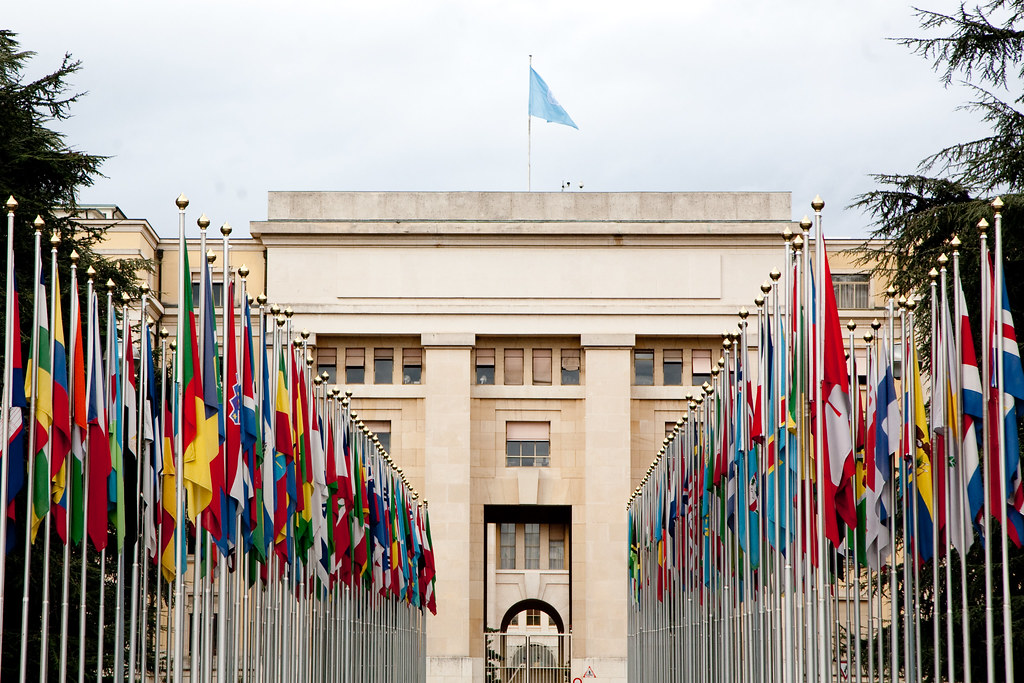
“United Nations Geneva” by izahorsky is licensed under CC BY-NC-ND 2.0.
The UNGPs were crafted by the United Nations (“UN”) to provide a framework for States to protect human rights in congruence with businesses transactions. The framework provides a pathway for States to enforce human rights obligations in arbitration against businesses who are in violation, either as themselves or their contractors. The State has a duty to provide guidance to businesses regarding land access and use, and how they should communicate their human rights protection practices, including utilizing financial reporting requirements (i.e. wages). With an increase in conflict, which is correlated to increased human suffering, such as gender-based and sexual violence, States must enable businesses to address possible human rights violations before the conditions deteriorate. Beyond States’ obligations, businesses also have an obligation to prevent and mitigate human rights abuses. However, the scale of their responsibilities depends on the individual business. The UNGPS also mention the importance of strong judicial mechanisms, such as arbitration. The UNGPs provides a starting point which States and businesses can use to uphold human rights within the dispute resolution section of a commercial contract. For example, a commercial contract could rely on UNGPs seventeen through twenty-one to ensure that employees are protected from hazardous health conditions, given fair hours, and a livable wage. Finally, the UNGPs maintains that state-owned enterprises and corporations are responsible for their contractors’ treatment of workers.
The UNGP’s protection of human rights in business can most effectively be amplified by the HR which applies to any type of claimant and respondent, and uses the definitions found in the UNGPs. Notably, the HR contains a mechanism for the appointment of an emergency arbitrator to ensure violators do not drag out the arbitral process and prevent the stoppage of ongoing human rights violations. With the assistance of the UNGP and HR, arbitral tribunals must conduct hearings with cultural sensitivity, a “rights-compatible process,” and take human rights into account when resolving disputes. During arbitral proceedings, a tribunal may impose interim measures to safeguard the human rights violation at issue to prevent serious harm. The HR emphasizes transparency in the arbitral proceedings, but not at the cost of safety, privacy, and confidentiality concerns.
One potential complication with using the UNGPs include vagueness within the principles. The UN writes memoranda for broad applicability but fails to provide States and businesses with concrete examples of how to protect human rights. Whereas the HR provides much more practical information for arbiters and the contract drafting process. The language of the document itself describes what parties and tribunals may do, but the commentary lays out applicable information, including the use of specific words in contracts and arbitration decisions. Some practitioners may find the language within the HR too limiting and formulaic since the document lays out what may happen and with whom at each step of the arbitral process. The overall goal of both documents is to encourage States and businesses to protect their workers’ human rights. Since neither the UNGPs nor HR are binding, the ICC Court should incorporate them into its rules that parties must follow during arbitration processes.
If the UNGPs and HR are adopted, they would offer a framework for grievance mechanisms within the dispute resolution section of commercial contracts. The UNGPs provides a framework that allows individuals to safely report suspected human rights violations and gives the business the opportunity to remedy them. Additionally, the HR is an in-depth document that explains various dispute resolution clauses for contracts including: when transparency is appropriate, how arbitral tribunals should operate, and general rules of procedure. Enforcing arbitral decisions comes with its own set of difficulties, such as the lack of transparency regarding outcomes in which awards are binding on the parties. However, for State enforcement of arbitral decisions, they should have other judicial mechanisms within their government to enforce contracts or prosecute violators of human rights. While this is not the goal of arbitration, prosecution is still a powerful tool States can use to ensure businesses are following the arbitration decisions they agreed to.
“The International Chamber of Commerce International Court of Arbitration (“ICC Court”) should adopt the United Nations Guiding Principles on Business and Human Rights (“UNGPs”) and Hague Rules on Business and Human Rights Arbitration (“HR”) to reduce human rights violations in commercial contexts. Doing so would promote better training and information sharing, support victims in seeking redress and help prevent future abuses.”
Malini Prasad
Arbitration is a venue where States can put pressure on multinational corporations to tighten supply chains or rectify past issues. While arbitration allows for more autonomy and privacy of the parties over the arbitral process, commercial arbiters should be required to have special licensing, training, and education on human rights within supply chains. The ICC Court can protect human rights by adopting the UNGP and HR.
International arbitration often involves large multi-national conglomerates who are focused on cutting costs and maximizing profit and efficiency. This implicates global supply chains, and the possibility of human rights abuses at all levels. The ICC Court should adopt the UNGPs and HR to reduce human rights violations in commercial contexts. Doing so would promote better training and information sharing, support victims in seeking redress and help prevent future abuses.

