By Genevieve Francois
Introduction
The American arbitration system is governed by the Federal Arbitration Act, which creates a structure that allows companies to mandate arbitration for dispute resolution. This format forces disputes to be resolved privately rather than in the more public arena of the court system. Mandatory arbitration clauses are often purposefully hidden within extensive, complex contracts containing confusing legalese. This system of dispute resolution has rapidly increased in use. In 2022, there was a 467 percent increase in forced arbitration cases. Eighty-one of the one-hundred largest companies in the United States use forced arbitration for customer transactions. In addition, 56.2 percent of private-sector, non-union workers were bound to mandatory arbitration agreements in 2018. Many people commit to mandatory arbitration without knowing what they are agreeing to. In one study, ninety-nine percent of American consumers reported a lack of understanding of forced arbitration contracts.
Social movements such as Black Lives Matter and the Me-Too movement have confronted the realities of the arbitration system. While there have been some changes to addressing sex discrimination claims, the resolution of race-based claims still frequently takes place behind closed doors. The opaqueness of mandatory arbitration clauses, together with the lack of diversity in the Arbitrators, leaves minority clients particularly susceptible to poor consequences of the American Arbitration System.
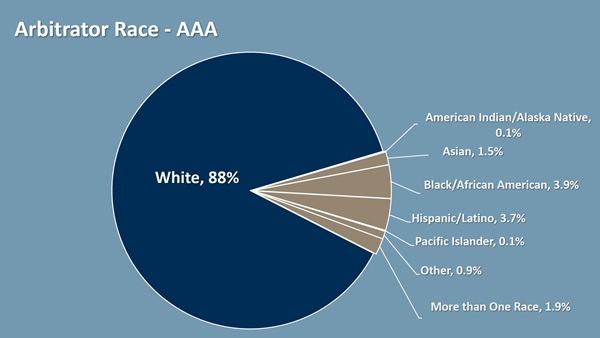
Where White Men Rule: How the Secretive System of Forced Arbitration Hurts Women and Minorities, American Association for Justice, https://www.justice.org/resources/research/forced-arbitration-hurts-women-and-minorities (June 2021).
Demographics of American Arbitrators
While critique of the American Arbitration System is not new, concerns about diversity have not always received the same credence as criticism for sexual assault-based claims in arbitration reform. Exact demographic breakdowns range group to group, but there is one glaring point of commonality among arbitration groups: most arbitrators are white men. A 2022 Member Survey of the National Academy of Arbitrators found that ninety-three percent of members were Non-Hispanic Whites and seventy-nine percent of members were males. Separate studies performed on the demographics of members in the Judicial Arbitration and Mediation Services, Inc. (JAMS) and the American Arbitration Association (AAA) produced similar results. While there is also a significant lack of both female and minority arbitrators, the studies and surveys showed that people of color were underrepresented to a greater extent. Interestingly, not only are arbitrators less diverse than the American population, but they are also less diverse than federal and state judges. A 2017 study found that only 8.72 percent of JAMS arbitrators were people of color, compared to the 20.2 and 19.6 percent of federal and state judges, respectively. Eighty-five percent of the National Academy of Arbitrators (NAA) members expressed that the lack of diversity was an urgent problem, and ninety percent of members indicated that they would be very supportive of efforts to increase the diversity of their members.
There are numerous suggested causes behind the lack of diversity in American Arbitrators. Some claim that there is a lack of diverse arbitrators available to fill these much-needed gaps in the system. Concurrently, the legal field, has been found to utilize personal connections and networking significantly in hiring considerations, providing for another burden to entry for diverse arbitrators.
Recent Legislation
In March 2022, Congress passed the Ending Forced Arbitration of Sexual Assault and Sexual Harassment Act (EFASASHA) under the Biden Administration. This monumental legislation only removed the arbitration requirement in sex-related cases, keeping race-related discrimination cases subject to arbitration. Congress attempted to remove race discrimination claims from forced arbitration via the Forced Arbitration Injustice Act in 2022. The act would have banned “not only mandatory arbitration of race discrimination claims but all ‘predispute arbitration agreements that force arbitration of future employment, consumer, antitrust, or civil rights disputes.’” This legislation passed in the House, but stalled in the Senate.
Structural Inequities in Mandatory Arbitration Proceedings
The push for reform of mandatory arbitration agreements, along with reflections on the lack of diversity in arbitrators, stems from biased results against people of color in arbitration proceedings. Without meaningful change, people of color continue to fall victim to the enforcement of arbitration agreements, and corporations continuously seek to silence claims of racial discrimination.
Workers who are bound by forced arbitration agreements are more likely to be victims of wage theft and are often left without a realistic way to recover lost wages. Those subject to mandatory arbitration agreements are also less likely to pursue arbitration and seek justice. In 2018, despite there being 826,537,000 consumer arbitration provisions in force, the two largest arbitration firms – AAA and JAMS – only had 6,000 consumer arbitrations. Even when claims are filed, many do not result in meaningful relief. In 2019, the AAA only resolved 895 consumer arbitrations despite the thousands that sought their services.
Consumers and workers forced into arbitration also face significant financial disadvantages compared to the large companies they challenge. A study of AAA and JAMS of consumer arbitrations between 2014 and 2018 found that consumer prevailed in receiving a monetary award in only 6.3 percent of 30,000 cases. Among employers that have binding arbitration agreements, ninety-eight percent of employee cases are abandoned before seeking resolution.
These poor odds, combined with documented biases against people of color, mean that mandatory arbitration raises serious concerns for minority claimants. With that said, bias and lack of diversity among arbitrators does not only impact minority consumers or employees with a lack of resources. In 2018, rap pioneer Jay-Z was involved in a dispute with the clothing company Iconix. Jay-Z utilized AAA for their arbitration services, and AAA did not provide his team with a single Black arbitrator to choose from.
“The opaqueness of mandatory arbitration clauses, together with the lack of diversity in the Arbitrators, leaves minority clients particularly susceptible to poor consequences of the American Arbitration System.”
Genevieve Francois
Conclusion
An arbitration system that works to provide clients of color menial monetary awards and keep their voices from being heard publicly will never create true justice. Large-scale change to the arbitration system is necessary to provide equitable results for clients of color. First, enactment of legislation like the Forced Arbitration Injustice Act in 2022 would provide structural change that would prevent race-based claims from being forced behind closed doors. Second, it is important to increase the diversity of arbitrators. A system that better reflects those seeking its services offers a fairer system for non-white clients.
 The Arbitration Brief